
Placebo and Performance Pulls
Goalie Note #5

A stark realization struck me while watching the playoffs in 2025. There are two reasons for a coach to change goalies discretionarily: one is for performance reasons, the other is for a placebo effect.
If you take offense to this categorization consider it more favourable than “deck-chair shuffling”, o captains, my captains.
I say placebo effect because goalie changes occasionally have an ability to spark a direct reversal in the balance of play-driving — what traditionalists might call “momentum”. The placebo effect is an apt analogy for this phenomenon because they both a) do and don’t make any sense and b) are not something you can repeatably leverage.
That’s right, coaches, putting in a worse goalie will — at best — have only psychosomatic benefits for your team. Now, to be as clear as I can, I consider medicine to be the weakest of my knowledge competencies — but I do appreciate a good methodology.
As you may or may not know, a placebo is a treatment used in blind medical trials intentionally designed to have no actual effect on the patient — since the entire point of a medical trial is to try the medicine. Weirdly enough, however, the fact that a patient receives treatment at all can actually cause a reported improvement in their state — despite the fact they’ve intentionally been not receiving any real medicine. This improvement is called the placebo effect.
Now, performance pulls are exactly what they sound like: a goalie is pulled because their performing poorly and the coach wants to put the other goalie in. In my experience, these are typically done more aggressively than placebo pulls. The simple reason being that if you’re goalie has already let in a multiple bad goals, there’s the risk that more are to follow: best make the change while there’s opportunity to do something about it.
Now, in spite of this article’s title, there’s a secret third option for making a goalie change: rest. All three can overlap, making it very rare that any one change is motivated by only one of these factors. Let’s examine a few case studies of goalie changes.
Case Studies
2004 ECQF Game 7 Maple Leafs vs. Senators — Goalie Pulled: Patrick Lalime
This game is infamous — well, the first period is, rather. Ottawa Senators’ goalie Patrick Lalime infamously let in two weak goals to Joe Nieuwendyk from roughly the same spot on the ice: on the blocker-side boards by the outside hashmarks. There was also a fairly legit goal he allowed to Chad Kilger about 90 in-game seconds preceding Nieuwendyk’s first goal. Actually, this is still a slightly iffy goal on Lalime’s part. From the Leaf’s POV, this goal is well-earned: Tie Domi wins a forecheck battle, has the presence of mind to spin around and find Kilger parked just inside the near-side post to pop it over Lalime’s…pad??? There’s not really a good angle on it. For Lalime, though, he moves too much here. Kilger is just inside the near post and puts it short side. Watching the replay about ten times, it’s clear that Lalime didn’t know Kilger was there and that explains why he over-pushes on Domi’s centering pass. Were Lalime wise to the lateral whereabouts of the Leaf’s winger, he likely makes a slighter movements — I could imagine an ad-hoc VH1 being implemented, or even a two-pad stack, or maybe just squeeze the pads. All this said, Lalime almost makes this save even with bad process.
The next two goals are stuff of infamy. But before I talk about that, I want to show some foreshadowing. In this clip from before the Kilger goal, there are two shots: one from outside the line that dives past Lalime’s blocker, going wide, and one from the short-side wall just above the hashmarks that Lalime catches against his blocker. Something to think about.
But here is the first of the two goals that launch this game into infamy. Watch the clip. Watch every angle of it provided —especially the second one. Greg de Vries (#5 in white) deflects the puck right off the release, almost. This causes the puck to spin and dip back towards Lalime’s blocker side: which explains why Lalime reaches across his body for this puck. Two things about this play are true: (1) this shot is really tricky to pickup — it has some decent pace, it has some spin that creates some movement, and it has already deviated from the trajectory suggested by Nieuwendyk’s release — and (2) Lalime could have saved this shot had he just used his blocker. As mentioned, these two goals came under 90 seconds apart in-game. Senators’ coach Jacques Martin calls a timeout. That calms things down until the final minute of the period.
That’s when there’s a third goal, Nieuwendyk’s second. This one is also bad. Redden (#6 in white) creates the deflection off the release this time, but it squibbles five-hole. This is the kind of goal that is rarely seen today thanks to the near-universal adoption of the butterfly. If Lalime had dropped, this is a breadbasket save. Now, there are a couple of angles, when slowed down, suggest Redden’s deflection may have altered the trajectory such that it kills otherwise elevation of this shot, making Lalime’s rection more sensible. By the time the next period starts, Martin Prusek is in net for the Senators.
Prusek’s having a good year for the Sens. Appearing in a career-most 29 games and post a career-high 93 GA%–, Prusek is about as ideal a backup you could hope for. He only lets in one goal the rest of the way, but the Sens only have a goal to show for it.
So, what kind of pull was this? Well, it was a performance pull predominantly. Watching the period, you got the sense that the Sens weren’t being hemmed in their zone. Both of Nieuwendyk’s goals came off transition and Kilger’s goal was off a puck freshly dumped in. The Leafs had the balance of powerplays, in the first, but that wasn’t the issue, truly. The other thing to consider is that intermissions are a natural break in the game and, assumedly, in momentum.2 As such, a goalie change between periods is usually due to performance as coaches have a finite number of ways to “hard reset” their team: timeouts, intermissions, and switching goalies. Doubling up on either of the first two with the latter is a not going to have a multiplicative effect. Thus, we can assume that Martin had seen enough by the end of the first. Overall, I’d give this move by Senators coach Jacques Martin a Gabarr seal of approval. It’s only with over two decades of hindsight and an extremely open mind that I consider the two Nieuwendyk goals as potentially confounding rather than outright soft. I don’t mind Martin seeing this as a performance issue in the moment.
2022 WCF Game 1 Oilers vs Avs — Goalie pulled: Mike Smith
God, I think this 2022 Oilers team is the reason why the team has only been somewhat legitimized by consecutive cup finals appearances: a team with a stacked core of forwards and a defence that allows xGoals against so viscerally, it can only be described as “hemorrhaging” — at least that’s the reputation. The reality is less visceral, but the former describes this game, at least. The 2022 Avalanche are a team that somehow does not get enough credit due to subsequent years of injuries and not being a perennial contender. Regardless, I consider these two teams — be it wider discourse or the actual fanbase — to be in the greatest need of a moratorium on goalie discourse, as they have chronically underestimated the level of play of their goalies in recent years.
Note that Kuemper is also pulled in this game, but it is due to an injury.
In this game, both teams traded goals off the rush, making arguments of performance pulling alone a bit difficult to substantiate — sure, a crocheted blanket probably won’t stop this bleeding, but maybe we could try not opening an artery next time!
The first goal against is off an Evander Kane breakaway that the man just sinks over the glove-side pad of Kuemper. 1-0 Oilers.
The Avs tie it up on a 2-on-1. Smith dives accross as his D plays the shot, and the puck is subsequently passed over. Smith pushes across in desperation, leaving his glove to deal with most of the coverage on the top 80% of the net. Compher, unfortunately, is a bit further out from the play than is typical of the “stuff” range, and has time to catch and release into the upper part of the net. Smith’s desperation suggests he did not fully pick up Compher backdoor or was simply anticipating a bang-bang play. Regardless, it wasn’t a horrible goal to allow — the D has to take away that pass, even at the cost of allowing that free shot. 1-1.
The next goal against Smith is off an inside-the-Blueline breakaway by Nathan MacKinnon. Based on the circumstances — and especially who scored it — I’m willing to write this one off for Smith, but I want to talk about it anyways. MacKinnon receives the puck up the middle, just outside the Blueline in a pass from Toews. He charges into the zone, having to adjust to his left to recover the puck after putting it to that space. Approaching the net, MacKinnon threatens to cut across and around Smith, but Smith is wise to his intentions and preps a pokecheck. Seeing that Smith is very much against him having puck and deking around him, MacKinnon tactfully finds a compromise between their respective demands and slips the puck through Smith’s 5-hole and into the net. 5-hole goals never look good, but on breakaways, they’re typically more forgivable.
Off the very next faceoff after Edmonton tied it up, Colorado forces a turnover and Cale Makar comes screaming down the right wing and just beats Smith right by his glove-side ear. 3-2. I’m going to be a bit pedantic and say that Smith makes this save if he just keeps his feet. You may be shocked to learn that reality is, in fact, more complicated than that. If we recall my concepts of immediate (everything a goalie covers with the torso and legs, plus the five-hole) and effective (the rest of the net) coverages, we can analyze the trade-off that Smith has to have already decided on in order to have a chance at this shot. Smith plays further back in his net than most, trading off some immediate coverage for mobility, trusting his effective coverage to account for that difference. Watching clips of Smith — especially from his legendary 2011-12 — it’s shocking how well this works for him. It doesn’t here. Smith snaps down for the shot. Recalling again that there are a set of trajectories for each puck to hit the net. It’s not clear here the exact number of those trajectories Smith is trading off here, but impressionistically, Smith is forcing Makar to make a tougher shot. It just so happens that the best Defenceman in the league, Cale Makar, is equal to the task.
The 2nd period starts and the game is 3-2 —I’m sure the video coaches are going to have a field day with this one: especially since this is only game 1 — but it does not remain thus for long. Again off the rush come the Avalanche. Kadri takes an initial shot, which Smith stops, but the rebound, temporarily lost in a net-front battle, finds Kadri who deposits it in the net to make it 4-2. I mean, what should Smith have done? Simply pick up where the rebound actually was? I wonder if he thought of that yet.
McLeod makes the game 4-3 on a play nearly identical to Kadri’s goal.
Mikko Rantanen reestablishes the 2-goal lead with an absolute rocket that he just walks into. The last goal on Mike Smith is the exact kind of freak bounce that tormented Jake Oettinger in the first round of the 2025 playoffs. A point shot from Cale Makar hits Compher’s body and deflects into the net. Absolutely nothing to be done about that. Like that, it’s 6-3 and the game isn’t even 26 minutes old.
This is a placebo pull. The volume of goals against is not ideal, but this sort of thing happens against the Avs. It’s also a rest pull as Smith has just allowed 6 goals in 26 minutes in game 1. Let him rest and reset and prepare for game 2.
2008 WCQF Game 3: Flames vs Sharks — Miikka Kiprusoff
I’ve wanted to talk about this game for a while. Flames goalie Miikka Kiprusoff had been excellent through the first two games of this series, but not so much this one. San Jose got things going early with a goal off the rush on a powerplay from Ryan Clowe. It’s a bit of a strange one: 100% a high-danger chance, but Kiprusoff does himself no favours by trying to slide into this one. I’m also not sure where he gets beat. The footage is so grainy. I know it’s blocker-side but I’m not sure if it’s a tick off the post and in or a shot through Kiprusoff.
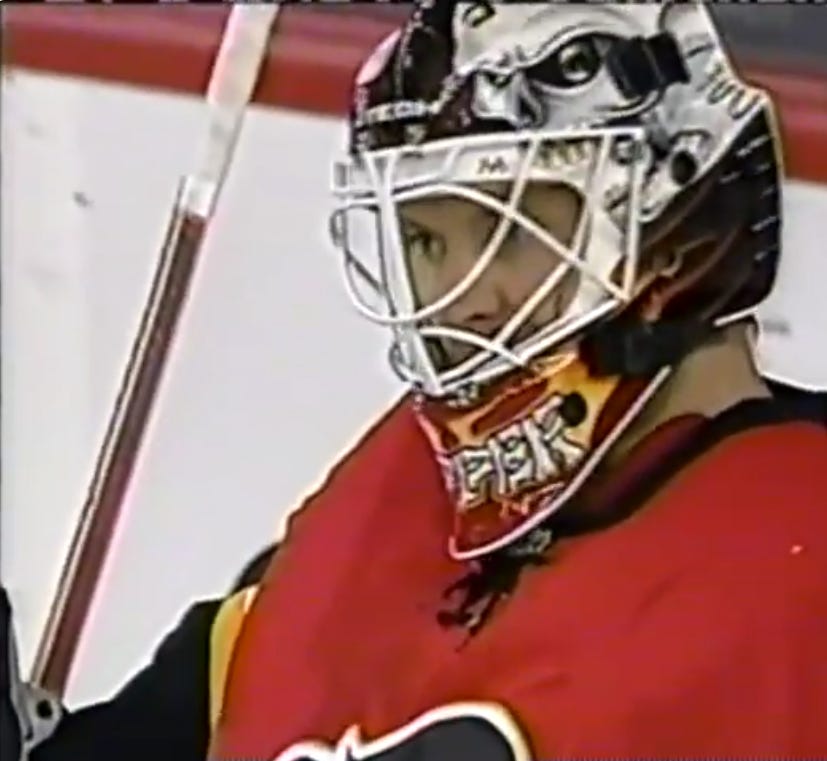
Patrick Marleau increased the lead to 2-0 off a play where he took a hit to continue the cycle up to Pavelski on the boards who found Clowe, who threw it on net where Marleau, not really being engaged with by Phaneuf, tipped it home. The next goal came off the very next faceoff. Thornton enters the zone with possession and stops up high, feeding the puck to Cheechoo who has a head of steam entering the zone. Cheechoo fakes the shot upon reception, but opts to carry it straight in, then around the ever-pylonesque Dion Phaneuf cemented at the faceoff dot, who watches Cheechoo curve towards then net. Kiprusoff, perhaps wary of the short-side threat from Cheechoo over-commits as Cheechoo completes a wrap-around. He throws the puck out to Douglas Murray of all people who fires the puck into the net before Finland’s finest ginger can correct his positioning. 3-0.
Coach Mike Keenan has seen enough: he sends in Cujo to relieve Kipper. This game represents the single-worst dFSV% I’ve seen (albeit it is literally from 3:33 of TOI). –40.75. 0.55 xGA. Curtis Joseph takes the net and Calgary begins picking away at the lead. 3-1 going into the first intermission. 3-2 by the halfway point of the second. Tie game 1:18 into the third. Owen Nolan makes this the true geezer game by making it 4-3 Flames with 3:45 left in the 3rd. Cujo stopped all 22 shots against for a 1.33 GSAx on the game. This would be Cujo’s penultimate playoff appearance in his Hall-of-Fame-worthy career. His final appearance would be — fittingly — a Game 7 1st-round loss, once again relieving Kiprusoff.
Keenan’s pull of Kiprusoff was sound. Despite the ghastly stats, it wasn’t exclusively a performance pull, necessarily. There’s a lot the D could have done on those plays and it was game 3 with a series score of 1-1. Kipper needed a reset for the series and the Flames needed a reset for the game. The result was exactly what you hope for. Truth be told, however, Nabokov didn’t have a good game either — which allowed Calgary the opportunity to come back.
2025 SCF Game 4 Oilers vs Panthers — Stuart Skinner
I’ve actually ranted about this game in notes already, when it happened and wrote an article encouraging Knoblauch to go with Stuart Skinner in game 5.
The scoreboard circumstances of this game and the Lalime game (noted above — actually, Patrick Lalime’s goals against are so infamous, I could have left it as pure anaphor and not specified further) are identical, but the tape and possession stats tell a wholly separate tale. Florida was all over the Edmonton Oilers on 5-on-5 and the man advantage. Skinner was absolutely bombarded. Skinner bent, for sure, allowing 3 goals against, but nearly broke even in his GSAx. Put another way, Skinner faced unblocked shot attempts in concentrations that xGoals cannot fully account for — and yet still managed to nearly meet its expectations. The eye test flat-out corroborates this: none of those goals were atrocious — they weren’t unstoppable, but I don’t think this was strictly a performance pull.
You can argue all you want about the necessity of this move, but the reality is that the Oilers won — not from significantly improved goaltending, but because they simply stopped getting their brains beaten in by the Panthers. Yes, Pickard technically outplayed Skinner in GSAx, but I’m going to invoke small-sample doubt and call their performances functionally equal. This is pure placebo — and as such, Knoblauch mistakes Pickard for the cure to his team being outplayed, and starts him in game 5. I’m not blaming Pickard for that loss, but starting your backup in a cup final game is usually not the master stroke you think it is. Pickard wasn’t mid-heater and Skinner wasn’t injured or less than 100%. This was an unforced error for sure, but if we’re being honest, it was an inconsequential one.
2025 R3 Game 5 Oilers vs Stars — Jake Oettinger
And at last, the true purpose of this article is laid bare: I wrote many a note on this decision back in June, when it happened, but it is worth repeating. Former head coach Pete DeBoer said of the move that if it worked, he’d look like a genius and they’d be in Edmonton for game 6 (at the time he made the comment). And while I don’t think I can blame a coach for feeling this way in a league as scrutinized as the NHL, I can point out that this moved smelled of panic. DeBoer had already used his timeout — a reasonable move after the two quick goals. But to hastily append a goalie change on top of that was a bit of overkill from my view. But a little overkill never hurt anyone. The real and tangible issue was the fact that this was an elimination game — and yes, we covered other elimination games on this list — but the issue here is a combination of the score (2-0) and, more importantly, DeBoer made an apparent mental calculation that his star (note the lowercase) goalie was underperforming to such a degree that he was willing to take his chances on his backup (who, notably, still performed well in the regular season) based on a sample of two high(ish)-danger shots, and was willing to forgo further use thereof for the rest of the game. To grossly oversimplify, 2 goals over the course of 50ish minutes should be very doable — even in the playoffs! The mental calculus of a performance pull is not just straight SV% extrapolation: it’s actually —unfortunately— an extrapolation of trust. The context-rich eye-test is extremely useful in small samples. The reality is that there was nothing in those 2 goals that suggested Oettinger was not this team’s best bet to manufacture a comeback. Had this been a non-elimination game, I’d be slightly less critical of this decision, but it still wouldn’t have made much sense either, because there’d be no rest factor to consider — he wasn’t getting over-worked at all. So, if there was no rest factor, and I believe the performance angle has no legs to stand on, why is this a bad placebo pull? If it’s 10 minutes into the game and your opponent has only 2 shots on net (including on a powerplay), they’re on pace for 12 shots over the course of the game! You’re likely still in control of the game, and thus a bump is not what your team needs. In fact, this makes the timeout seem a bit over-aggressive. The Stars had a PK breakdown and a breakaway against. Talk to the D about it. The reality is that timeouts are a resource when you’re chasing games. The fact that DeSmith is scored on shortly after the change on a net-mouth scramble is truly unfortunate, and is largely inconsequential to my analysis. I believe that DeBoer could have done nothing and still engineered similar success because there exists score effect: essentially, the more a team leads by, the less they will tend to dominate play-driving metrics like CF%, usually as a behavioural choice to try to prevent the exchange of high-danger chances. The losing team will conversely demonstrate the opposite behaviour. This actually underlies the goalie-change placebo effect.
To close the book on DeBoer, this was his last game as Stars head coach. Was it because of this move? Not so much the move itself as what it represented: a stubborn, headstrong coach that didn’t adjust properly in playoff situations. Let’s return to that “I would have been a genius” comment. It’s fair sentiment for a coach to have. In some way, coaches at any level need that kind of self-belief to not be frozen in indecision. It’s saying that your job is to make decisions and you cannot be afraid of how you could look. But, with that in mind, that’s not carte-blanche to make any kind of decision without regard for its risk. We should view coaches’ decisions through the lens of risk-reward and determine whether the situation calls for that level of risk. 2-0 with 50 minutes to go in an impressionistically even game was not the time to switch goalies.
Summary
If we go down through the lists of pulls, my verdicts were
Patrick Lalime — Performance pull: some iffy goals created a 3-0 hole in an otherwise even game.
Mike Smith — Placebo/rest pull: 6-3 halfway through game 1, this is probably the best decision. Wouldn’t call this performance as some of those goals were snipes.
Miikka Kiprusoff— All of the above: I will never, in my life, say, “you gotta hand it to Mike Keanan”. He did, however, make a decision here that was both sound and worked as intended. A 3-0 deficit in a non-elimination game that early in the first period on goals that were a lot to do with statuesque defence allowing 2 fairly dangerous shots and one contextually difficult play but were also still completely stoppable is a textbook goalie switch scenario. So, yes, it did work, but the way forward was obvious for Keenan and the rest of the team did their part as well. And that’s why it ended in a win.
Stuart Skinner — Placebo pull: I think there were a lot of reasons to let Skinner stay in., but the Oilers did need some sort of spark to stop being hemmed in (not taking penalties would have helped for sure).
Jake Oettinger — a confounding decision: the goals weren’t bad enough to justify a performance pull like Lalime’s, nor the deficit so deep to warrant a pull like Kiprusoff’s, nor the balance of play so imbalanced to require a placebo pull like Skinner’s, nor the context of an elimination game able to justify a rest pull like Smith’s.
Conclusion
The ultimate lesson I’m trying to teach is that if you make a purely placebo pull, you cannot conflate it with a performance pull. Remember: are you in the control group or is this the actual cure? It’s your responsibility as a coach to know the fricking difference — it’s a responsibility that comes with clipboard privileges.
Despite advances in understanding of goaltending, there’s still plenty of confounding decisions to go around. But I hope this proves instructive to the idea of changing goalies in playoff games.
The VH or Vertical-horizontal describes the pads’ positioning relative to the near-side post: one is vertical and parallel to the post, the other is horizontal and flat on the ice. Not to be confuse with the RVH or reverse horizontal, vertical.
This is actually something that could be potentially tracked by proxy of some weighting of shot-attempt volume, danger, time of possession, and zone time across a rolling timeframe.