
This Is Not The Same Jordan Binnington
Jordan Binnington is not exhibiting the same processes that gave him success in 4 Nations

If you have followed my publication for a while, you know was not in favour of Jordan Binnington’s inclusion on the 4 Nations team. You’ll also know that I was among his most ardent defenders before the gold medal game. I thought that people overblew the goals he allowed. I thought he got better as the tournament went along. I also knew that, statistically, he had begun to turn his season around in St. Louis before the tournament began.
What gave me this tentative confidence was how he looked while making saves and the relative difficulty of the goals he allowed. Jake Guentzel’s goal against him in the preliminary round was one where I differed greatly from the common consensus. Guentzel had received the puck off the rush and put a quick release 5-hole that simply beat Binnington to the ice. People panned this goal, whereas I saw it as a good process play where Binnington forced the shooter to make an elite play. It’s just really unfortunate that Jake Guentzel is the exact guy who can make that shot, because that’s the exact shot he’d choose even without the constraints of that particular play. He’s also so underestimate-able.
My conclusions were that, while I disagreed with his selection, and still did not think it was justified, he did have a good tournament and made difficult saves in high-leverage moments. Unfortunately, the narrative suggested an intrinsic skill of high-leverage performance for Mr. Binnington. And that leads to where we are today.
This is not a hit piece. This is not personal. I’m not even going to be showing goals against. I will simply be showing clips of Jordan Binnington in the 4 Nations tournament and… well, no Olympic footage because it’s not easy to access and I made this a last-minute article.
Let’s start with this clip from the Canada-Sweden game. The pucks moves from love to high, and Nylander, realizing he’s being closed on, lets a shot go from far-out which gets blocked. Binnington doesn’t drop. Binnington is patient, and that is something I have largely not observed him be throughout these Olympics.
The next one is this breakaway from the same game. Lucas Raymond is ahead of everyone but due to backpressure closing in, Raymond has limited options as to what he can do. Binnington has faced this situation a few times during the Olympics and has successfully navigated those chances, but none were as threatening as Raymond’s is here. Raymond takes a high backhand shot that Binnington gets his arm on. Binnington is, again, patient, moving across only as Raymond commits to the backhand. It’s worth noting that the one time Binnington faced an unimpeded breakaway, he surrendered a goal on an elevated shot. Most attempts on him in these Olympics have been pad-height.
Moving on to the OT of that game, there was this Zibanejad one-timer that Binnington stopped. Zibanejad leaves it for Rakell who promptly finds the former in space. Binnington reads the pass across and gets his stick on it, deflecting it out. I’m not sure if Zibanejad’s plan was to catch an over-exposed 5-hole, but Binnington had waited to read the shot release before moving his blocker to cut down the angle. This, in my mind characterizes Binnington when he’s on his game: patience in motion. He knows he’s fast enough to catch up to most plays, so when he gives himself time to read things as they’re happening and then commit, like with his stick on this play. Binnington has gotten away from that these Olympics and — as his bottom-5 GSAx suggests — this entire season.
This clip, from the same OT is actually something I have seen him do at these Olympics. It’s a similar backdoor pass, but the pass originates lower in the zone, so he actually covers his post (somewhat like Mike Smith off of faceoffs for those who remember that article). The pass from Forsling goes across and Binnington gets across pretty easily for what ends up to be a pad stuff-attempt. I also included the flubbed 2-on-1 that immediately preceded the game-winner just because it was there.
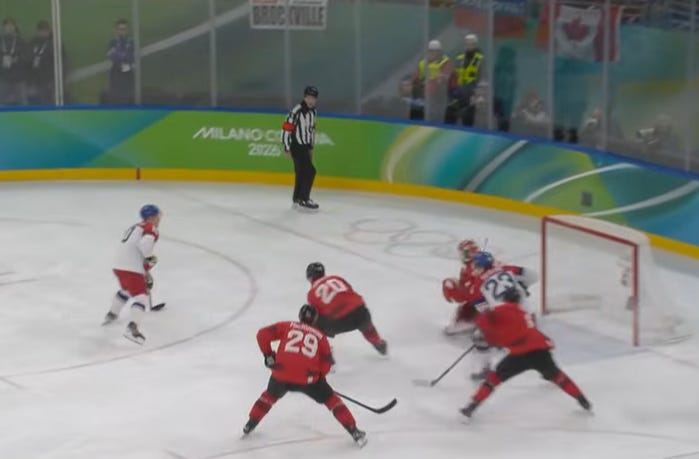
There actually wasn’t much to look at in the Finland game. But here’s Binnington making a save on Rantanen off a faceoff before dealing with Barkov on the rebound. It’s a good initial save on a difficult chance — which is already an improvement as he was making shaky initial saves on fairly straight-forward chances in the preliminary game vs Czechia (the first alarm bell for me) — but in terms of larger process, the way he stops himself on his recovery gives him a chance to get his pad in front of Barkov cutting back, who’s not having a good time to get this puck to settle. Compare that to the first goal in the quarter-finals against Czechia. He took himself out of the net, giving himself, no chance to stop the bankshot.
Speaking of that first goal, I’m reminded of it in this clip from the final game against the Americans. Werenski comes in on the blocker side, but instead of like in the Czechia game, where Binnington pushes over as he goes down just a bit, Binnington drops straight down on Werenski. It’s patient, it’s solid, and it’s reacting based on the play and not whatever whimsy of the day it is. He also gets his little bit of depth — something that he likes to do — before the release. Now, there’s not quite the same threat, and on the Czech goal, the puck carrier came across the zone, but it’s roughly equal dangers to shoot.
To end, because it’s currently just over 9 hours until puckdrop, I’m just going to post a compilation of his 3 OT saves from the final against the US. Watch through it.
Binnington straight-up looks completely different from his current form on these plays. He looks truly on top of his game in these clips. He’s tracking — his eyes follow the puck into his body — and he’s patient — responding to shooter action efficiently when it happens and without trying to get ahead of the play, and trusting his speed to catch him up before a shot release — and he’s reacting — same thing but with saves instead of movement. All the things I’ve mentioned in this article so far, he’s doing and he’s doing them as well as any goalie has. THAT is the man I went to bat for 12 months ago, even though I didn’t believe he deserved a spot on the team.
I’ve been looking for signs of that goalie in this tournament, and it’s not there. There are perhaps more charitable analyses of his plays It’s not just his GSAx, it’s his GSAx plus his actual process of stopping pucks. No amount of bad defence in St. Louis — the media’s explicit excuse for his poor play1 — can be blamed for not tracking shots in, not reading plays and passes, and not being patient enough to give himself the best opportunities to make some goddamn saves.
What happens on February 22nd, 2026 with Binnington in net and Canada facing a roughly equal opponent for the first time all tournament — and team they cannot defend against by simply dominating possession?2 As of writing, I don’t know. But we will soon. He could replicate his level of play from the 4 Nations. He could look like a guy posting a sub-0.870 SV% in the NHL. He could not be a factor one way or the other.
But I know that it won’t be because of some special-effect-ass ability in championship games, or whatever. It will be dependent on how whether or not he uses the repeatable skills that have brought him success in previous years.
And GM of St. Louis and guy who had final say on Colton Parayko’s inclusion on this team, Doug Armstrong’s implied excuse.
Broadcasts talk about the anatomy of comeback, but the anatomy of goalie insulation is to simply possess the puck most of the time and bust your ass back when you lose it, and limit shot attempts at all costs. That’s how you wallpaper over iffy goaltending. Just throwing it out there.