
Cayden Primeau Must Go
Being a Hater with Receipts

Cayden Primeau has posed something of an enigma to NHL GMs throughout his career. A 7th-round pick, he excelled in college with consecutive seasons of over 30 GP and over a 0.930 SV% and — prior to a fantastic 2024-25 AHL season — had maintained a remarkably consistent SV% in Laval. But the NHL is a different story. In 55 games over the course of 6 seasons with the Habs, Primeau generally struggled, posting a -0.82 dFSV%1. This figure is misleading. His 2023-24 campaign was solid, posting a 0.85 dFSV% over 23 games. That accounts for a plurality of his games by season. He’s been mostly horrendous in his other appearances in the NHL.
But this guy was also outstanding in the AHL last season, posting an 0.927 SV% with the Laval Rocket. Maybe he had finally put it together. He was traded to the Hurricanes at the 2025 Entry Draft, but claimed on waivers before the start of the season by the Maple Leafs to replace backup goalie Joseph Woll, who was on personal leave. Primeau has since played 3 games for the Maple Leafs, and I’m ready to declare that he is not an NHL-level goalie.
I don’t like being a hater. I try hard not to be one. I have multiple articles on this publication defending the play of Stuart Skinner, and another advocating for Alexandar Georgiev to get another chance in the NHL. Ultimately, I believe that if you’re going to hate on goalies in the NHL, you need receipts.
Well, I have receipts for Primeau. While any single small-sample miserable season for a young goalie should not be career-sinking — just as exceptional small-sample seasons promise nothing by themselves — consistently struggling upon promotion is good way to kill interest in further opportunities (unless you’re Mads Søgaard, for some reason). Compare this to the patron saint of young-goalie-small-sample- high-variance, Akira Schmid. With Schmid, there may be upside. He’s produced differently across multiple seasons. Can he catch on? Maybe he’s just still raw. Those kind of numbers might all be noise in either direction, but if an organization believes in his tools, they should be more than willing to give him a chance to establish himself.
So Primeau has trended towards consistently poor performance at the NHL: that’s strike one. The narrative that many have pointed to is that he struggles at the NHL level, despite solid-to-good play at the AHL level. This bears out, especially last season. But what is the underlying mechanism that causes this divide to repeat across his career. Most people in these cases turn to psychological factors to explain the struggles — confidence being the most commonly claimed issue. I hate these kind of explanations. Confidence and un-confidence are not experienced the same way by everyone and may not manifest uniformly across all players. Just because strong play and confidence are positively correlated does not mean that poor confidence causes poor play or all poor play during a stretch. In my mind, you’d need to be able to demonstrate odd and atypical mis-reads to even begin to suspect confidence being a consistent issue. If Patrick Laine hits three consecutive posts on fairly open nets, I’m not going to question his confidence; if he looks to defer when he gets a puck on the powerplay despite time and space, then you can start speculating.
With Cayden Primeau, I don’t think confidence should be considered. I just don’t think he can read the play at an NHL level.
This explanation fits into his statistical narrative: someone who has performed well at levels of play that are decently predictive of NHL success (the AHL, NCAA, WJC), but not in the NHL itself. What could the difference be? Roughly the same difference between the NHL preseason and regular season. The players are faster, the shots are harder and are released quicker, and plays develop more rapidly. If you can’t catch up to that, you’re in trouble.
Let’s look at the film.
The first goal comes off a turnover. it’s a 2-on-2 with Tavares (91 White) supplying back-pressure. Cole Silinger (4 Blue) has a step on Benoit (2W), while McCabe (22 W) has the other Blue Jacket forward tied up. Silinger needs to make something happen, so with a quick pull to forehand, he changes the angle to beat Primeau in tight.
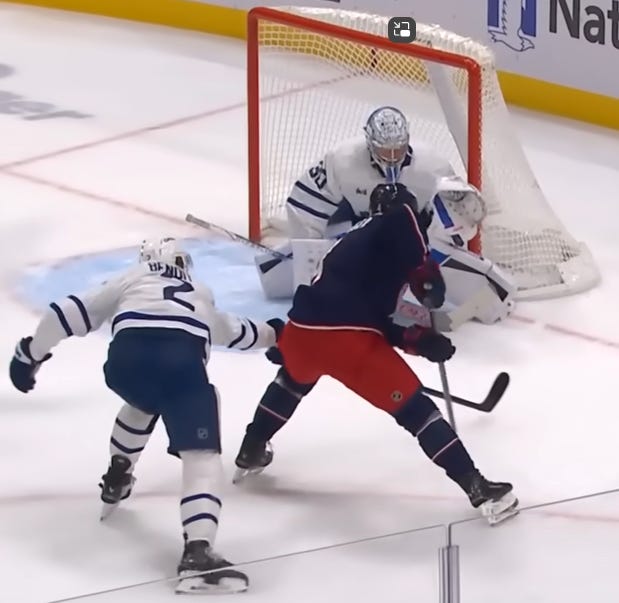
A major issue here is that Primeau’s paddle is going to the ice to cover his 5-hole. He should be able to seal the ice quickly from here. There are two main threats on this play: an immediate backhand shot, likely five-hole, but also a pull to the forehand (which is what happens) and some kind of shot. Benoit and McCabe converging on the net mean that Silinger won’t be likely to step to the middle here. He needs to seal off the blocker side here.
The second goal was a fairly standard case of the D’s stick completely altering the path of the puck upon release. Not much to talk about there.
The third goal, however, is a doozy. Everything is going pretty well for Primeau. He had just made a save on a fairly dangerous chance (0.132 xG per MoneyPuck) and tracks the rebound to the faceoff circle. Here’s where things go wrong. They go so straight-forwardly and unambiguously wrong that I made a diagram of the play.
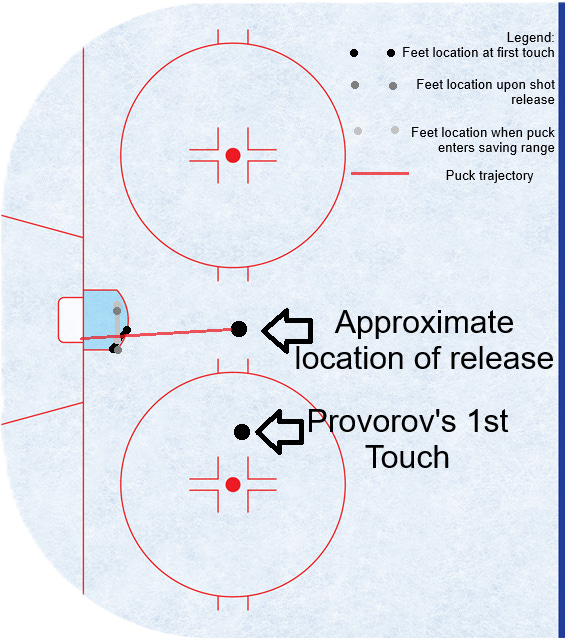
Yes, we have the video, but this really highlights something important: Primeau needs to set his feet here. Provorov’s first touch is a forehand, his second is backhand, and he just shovels it on net. It’s not a shot: it’s a big ol’ whack. Primeau does not need to slide here. Yes, Varankov (10) is screening, but Primeau can see all of that first touch and see the puck leave Provorov’s stick. He should be adjusting on his feet, driving his head and body to the other side to minimize his ‘blind’ time. This is plain-and-simply a bad read. His slide is also one of desperation. He basically manspreads and slides simultaneously, which is why his chest hits the ice as he looks behind him. And once again we see that paddle migrating down again as he’s beaten blocker side.
The third goal looks like it should be blamed on his teammates — who do create the circumstances, for sure — but this is simply a stoppable puck. Look very closely at where the puck beats him: right in that blocker-side 6-hole. His hands need to be active and out in front, or he needs to squeeze. The problem is not that he’s too slow. Goals 2 and 3 especially demonstrate that he’s not overmatched by the speed, but the plays themselves. He’s in desperation mode because he can’t process what’s going on, not because he can’t catch up.
The fourth goal is pretty bad too. Yes, Lorentz got hurt on the play, enabling this play to exist as an extended odd-man rush, but the 0.06 xG’s is really indicative of this being a highly stoppable shot. Primeau is simply never square. Watch the pass from Olivier to Fabbro. Primeau adjusts a bit, but he’s not square. Fabbro comes towards Primeau, but still beats him clean glove-side.
All-in-all, I’m not saying Primeau should never play another game in the NHL, but I am saying that he cannot be a long-term solution for teams, at least if he continues to play like this. The stats suggest that he’s overmatched, the narrative suggests it, and the film suggests it.
Per Evolving Hockey